On October 24, 2025, on Programmer's Day 1024, a day full of geek spirit, the "2025 Brain-Inspired Computing Forum and Brain-Inspired Computing Innovation Product Launch" was successfully held at the Hengqin International Innovation Center. The event was hosted by the Guangdong Institute of Intelligent Science and Technology and the Shanghai Brain Intelligence Engineering Center, and organized by Suiren (Zhuhai) Medical Technology Co., Ltd., Zhuhai Hengqin Neogenint Technology Co., Ltd., and other institutions. Together with more than 200 guests on site, we witnessed a historic moment—the official launch of the world's first brain-inspired intelligent computing system 'BIE-1'.
Grand Opening: Drawing a New Blueprint for Brain-Inspired Intelligence
The forum kicked off in a warm atmosphere. Leaders including Wu Chuangwei, Director of the Economic Development Bureau of the Hengqin Guangdong-Macao Deep Cooperation Zone, Li Pu, Director of the National Natural Science Foundation of China, Huang Nanyin, Secretary of the Party Leadership Group and Director of the Zhuhai Science and Technology Innovation Bureau, Zhou Zhaoming, Third-level Researcher of the Industry-University-Research Integration Division of the Provincial Department of Science and Technology, and Shen Yunjie, Third-level Researcher of the Frontier and Cross-cutting Technology Division of the Shanghai Municipal Science and Technology Commission, attended the forum opening ceremony, expressing their expectations and support for the development of the brain-inspired intelligence industry in Hengqin, this land of innovation. Zhang Xu, President of the Guangdong Institute of Intelligent Science and Technology, delivered the opening speech. As one of the organizers, we deeply felt the high hopes placed on breakthrough intelligent technologies by all parties.
The birth of 'BIE-1' (BI Explorer) marks the beginning of a 'mobile personal supercomputing' era for intelligent supercomputers, characterized by miniaturization, greening, personalization, universalization, and popularization. Intelligent computing power will enter personalized application scenarios in homes, offices, schools, and various industries in a more reliable, efficient, convenient, and user-friendly way, becoming a production tool accessible to everyone.
Academic Foundation: Top Minds Collide with Cutting-Edge Ideas
The subsequent academic report session presented us with the solid foundation and future direction of the brain-inspired computing field. Professor Zhao Rong from the Department of Precision Instruments and Brain-Inspired Computing Research Center of Tsinghua University, Professor Wu Si from the School of Psychological and Cognitive Sciences of Peking University, Researcher Du Zidong from the Institute of Computing Technology of the Chinese Academy of Sciences, and Young Researcher Xu Mingkun from the Guangdong Institute of Intelligent Science and Technology reported on the latest research progress of their respective teams from professional perspectives including brain-inspired computing and perception, computational modeling of spatial cognition, fully automated processor chip design, and brain-inspired intelligent models and plasticity algorithms.
The exchange content in the academic report session covered the multi-level technical challenges faced by brain-inspired computing from basic theory to engineering implementation and software applications, and also explored and discussed possible paths for brain-inspired intelligence to move from laboratory research to industrial applications, laying a good foundation for the continuous innovation of brain-inspired computing technology and providing useful references for the collaborative development of industry, academia, and research in related fields.
Major Launch: 'BIE-1' Intelligent Computing System Makes Its Debut
Launch Moment: Jointly Unveiling Revolutionary Products
In the product launch session, Cai Jiang, Chairman of Suiren Medical and Director of the Joint Laboratory of Multimodal Brain-Computer Interface Systems of the Guangdong Institute of Intelligent Science, told the magnificent R&D journey behind the product from darkness to dawn as an explorer!
As one of the core launch guests, together with Zhang Xu, President of the Guangdong Institute of Intelligent Science and Technology and Academician of the Chinese Academy of Sciences, Zhang Fangxiong, Executive Director of the Shanghai Brain Intelligence Engineering Center and Executive Director of the Guangdong-Hong Kong-Macao Brain Intelligence Center, Li Jianqing, Assistant Dean of the School of Computer Science and Engineering of Macau University of Science and Technology and Vice Chairman of the Guangdong-Hong Kong-Macao Greater Bay Area Brain Intelligence Engineering Research Association, Han Xue, Secretary-General of the Chinese Neuroscience Society, and Nie Lei, General Manager of Zhuhai Hengqin Neogenint Technology Co., Ltd., they jointly unveiled 'BIE-1' and introduced the core mysteries and excellent performance of this revolutionary product to the audience.
Core Breakthrough: Unique INN Brain-Inspired Algorithm
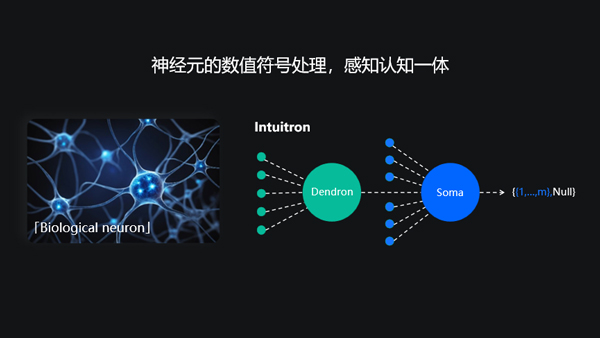
Chairman Cai Jiang introduced that the core technical breakthrough of 'BIE-1' lies in the independently developed unique brain-inspired algorithm—Intuitive Neural Network (INN), which can run various model training and inference including large models at high speed and efficiency. Its explainable brain-inspired learning network that unifies numerical and symbolic computing highly simulates the human brain's computing mechanism, integrating symbolic computing and data-driven ternary logic brain-inspired models, and adopts a brand-new 'structural information extraction—logical networking' architecture mechanism, which can not only learn efficiently but also provide explainable reasoning processes, solving the problem of 'black box' operations in traditional deep learning models.
INN also has few-shot learning capabilities, requiring only a small amount of data to extract patterns; supports continuous learning of new knowledge without forgetting previously mastered content; and can simultaneously process multiple types of information such as text, images, and speech, supporting multimodal data fusion processing.
Performance Revolution: Redefining Energy Efficiency Benchmarks
In terms of key performance indicators, based on the technical characteristics of INN, 'BIE-1' can complete 10 billion token training on a single CPU node in just 30 hours, with training and inference speeds reaching 100,000 tokens/second and 500,000 tokens/second respectively, comparable to traditional computing clusters requiring multiple high-end GPUs.
At the same time, the platform can reduce hardware costs by approximately 50%, reduce energy consumption by nearly 90%, with operating noise approaching that of a normal office environment, and significantly improve accuracy on multiple professional datasets. This is equivalent to achieving large-scale token output with an extremely small computing platform, expanding usage scenarios while comprehensively reducing the entry threshold and operating costs for the popularization of artificial intelligence. The vision of supercomputing power "flying into ordinary homes" is no longer empty talk.
Hardware Integration: Precision-Crafted Mini Supercomputer
Subsequently, Nie Lei, representative of the partner organization, interpreted from a hardware perspective that 'BIE-1' overcomes the problems of strong noise, large volume, high power consumption, and difficult heat dissipation of existing large-scale supercomputing facilities, achieving a combination of high configuration, small volume, and stability.
In a space only the size of a mini single-door refrigerator, it highly integrates 1,152 CPU cores, 4.8T DDR5 memory, 192T storage space, and 40G high-speed network interface. Even when performing the most complex inference tasks, the CPU temperature can be controlled within 70 degrees, and it can be easily deployed in homes, small offices, or even mobile environments, with low power consumption and low noise, truly a miniaturized supercomputer that makes high-end intelligent computing capabilities accessible.
Exchange and Outlook: Working Together to Create an Intelligent and Inclusive Future
After the launch session, Chairman Cai Jiang accepted interviews from multiple media outlets on site. He stated that 'BIE-1,' powered by brain-inspired algorithms, is not just a powerful computing device, but an intelligent foundational platform that can deeply understand and adapt to each user's unique needs. Its launch provides a brand-new solution for various industries to address the challenges of data and computing power scarcity, and will promote intelligent applications from 'one-size-fits-all' universal services to 'personalized' customized services, providing core momentum for the intelligent upgrading of various industries.
Looking ahead, 'BIE-1' is expected to achieve deep empowerment in hundreds of vertical fields such as finance, healthcare, and manufacturing. In terms of application scenarios, applications developed based on the BIE platform can achieve true personalized services through continuous learning. In homes, the system can learn the health data trends of the elderly and issue early warnings, or provide customized tutoring based on each child's learning characteristics. In office scenarios, it can deeply adapt to different employees' work habits and provide personalized workflow suggestions, achieving a 'personalized' intelligent office experience. In professional fields such as healthcare, education, and content creation, its professional and explainable reasoning capabilities are expected to become key tools for industry intelligent transformation. In terms of ecosystem construction, the BIE platform significantly reduces development barriers through improved dedicated toolchains, enabling more non-professional innovators to create powerful intelligent applications with the platform, jointly participating in and enriching the brain-inspired intelligence ecosystem.
This 'mobile personal supercomputer' that integrates breakthrough brain-inspired algorithms and innovative hardware design is opening a new door for the universal development of artificial intelligence with its unprecedented accessibility, liberating powerful computing capabilities from large computing centers. In the future, Suiren Medical will focus on the smart healthcare field, continuously exploring the deep integration and application of 'BIE-1' in scenarios such as home health monitoring, personalized rehabilitation guidance, and remote diagnosis support, working with partners from all walks of life to jointly promote intelligent computing power to benefit thousands of households.